
Silicon Sovereignty: India’s Narrow Path in the GPU Race

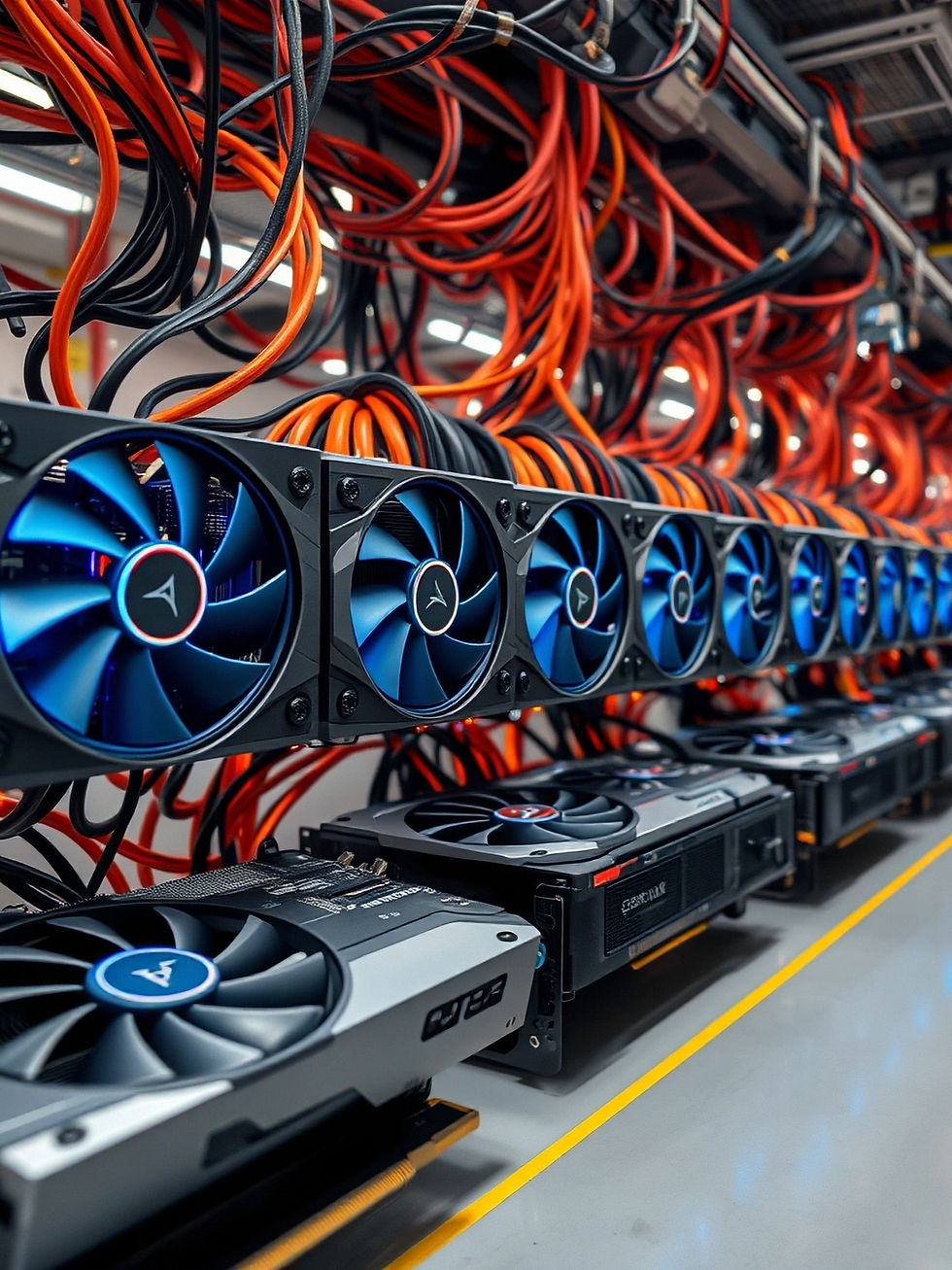
India is building 'AI superpower' ambitions on a cluster of GPUs smaller than what one mid-sized American university owns, and that gap is widening every quarter.
The country that produces nearly 40% of the world's tech talent is quietly rationing compute. And almost nobody is saying it out loud.
▸ The Tier Problem Nobody Talks About
In January 2025, the Biden administration's AI Diffusion Rule reshuffled global chip access into three tiers. Tier 1 - the inner circle of trusted allies gets unrestricted access to NVIDIA's most advanced silicon: H100S, H200S, and the upcoming Blackwell B200S. Tier 1 includes the UK, Japan, South Korea, Australia, and the EU. India did not make the cut.
India sits in Tier 2, alongside roughly 120 other countries. That means Indian companies and institutions face a cap: any single entity importing advanced GPUs beyond a defined threshold must apply for a US government license. The threshold is about 1,700 advanced chips, which is a lot until you remember that a single serious AI training cluster needs tens of thousands. (Source: US Bureau of Industry and Security, 2025)
The practical effect: ISRO, IITs, and Indian AI startups queue behind American hyperscalers who face zero such friction on their home turf. The race is rigged before the starting gun fires.
▸ The IndiaAI Math Doesn't Add Up
The IndiaAI Mission, launched under the Ministry of Electronics and Information Technology in March 2024 with a budget of Rs. 10,372 crore, has a centerpiece promise: 10,000 publicly accessible GPUs for researchers and startups. (Source: MeitY, 2024)
That number deserves scrutiny. Meta alone deployed over 350,000 NVIDIA H100 GPUs for its Llama 3 training runs in 2024. (Source: Meta AI Blog, 2024) Microsoft's Azure AI infrastructure spans hundreds of thousands of advanced GPUs globally. The University of Texas at Austin operates Frontera and the newer Vista supercomputer, with Vista alone packing 11,264 H100 GPUs more than the entire IndiaAI Mission's public GPU target. (Source: Texas Advanced Computing Center, 2024)
India's planned 10,000 GPUs, split across government researchers, IITs, startups, and healthcare AI projects, works out to a rounding error in global AI compute terms. If 500 startups apply for access, each gets 20 GPUs. You cannot train a competitive large language model on 20 GPUs. You can barely fine-tune one.
The cumulative installed base of H100-class GPUs in India across the public and private sectors is estimated at under 20,000 units as of mid-2025. (Source: NASSCOM, 2024) The US, by comparison, had already deployed over 3.5 million data center GPUs by the end of 2024. (Source: IDC, 2024)
▸ What Indian Companies Are Actually Doing
Facing structural scarcity, Indian players are improvising at scale, but improvisation is not a strategy.
Reliance Jio, through its partnership with NVIDIA, announced at GTC 2024 that it would build AI infrastructure in India using NVIDIA's DGX Cloud platform. The partnership is real, but the compute sits inside NVIDIA's global cloud fabric; India gets access, not ownership. Tata Group's cloud arm, TCS, and Tata Communications together have been quietly acquiring GPU capacity through partnerships with global hyperscalers, but again, the silicon is not domiciled in Indian data centers under Indian sovereign control.
Homegrown efforts are emerging. Yotta Data Services and NxtGen are expanding their GPU-as-a-service offerings, and ONGC-backed, CDAC-operated Param Rudra supercomputers have been deployed at three IITs under the National Supercomputing Mission. (Source: PIB, 2024) Param Rudra is genuinely impressive, but it runs on an NVIDIA A100S, one generation behind the current frontier, and the aggregate flops remain a fraction of what a single hyperscaler deploys for a single model training run.
Sovereign AI, a concept NVIDIA has actively sold to governments from France to Saudi Arabia, is a framework in which a nation owns its compute and data pipelines. India's version of this vision is underfunded and under-equipped. France committed €1 billion to a national AI compute infrastructure. The UAE built Falcon at the Technology Innovation Institute on a foundation of thousands of high-end GPUs, with no export-control friction, since the US classified the UAE as a close partner for chip access purposes. India's Rs. 10,372 crore IndiaAI budget, while substantial by domestic standards, translates to roughly $1.24 billion and covers not just compute procurement but also fellowships, datasets, application development, and startup funding spread across five years. (Source: MeitY, 2024)
▸ The Investment Reality and the Startup Squeeze
For Indian AI startups, GPU scarcity is not an abstract policy problem: it is a burn-rate problem.
Renting H100 capacity on AWS or Azure from India costs between $2.50 and $3.80 per GPU-hour, based on current market rates. Training a mid-size foundation model, say, with 7 billion parameters, on a reasonably sized dataset requires anywhere from 50,000 to 200,000 GPU hours. That is $125,000 to $760,000 in compute costs alone, paid in dollars, to foreign hyperscalers, with zero strategic leverage or data sovereignty. (Source: Epoch AI, 2024)
Indian AI funding hit a record $1.7 billion in 2024, with companies like Sarvam AI, Krutrim, and Yellow.ai leading the charge. (Source: NASSCOM, 2024) But the majority of that capital flows straight back out as cloud GPU rental fees to Amazon, Microsoft, and Google. India is funding American infrastructure while calling it an AI revolution.
Venture capital is beginning to notice the structural problem. Early-stage investors increasingly ask founders not just about model architecture but also about their compute roadmap, because a startup that cannot train or retrain its own models at reasonable cost is structurally dependent on Big Tech's pricing decisions made in Seattle and San Jose.
▸ The Path Forward Is Narrow But Real
Three genuine levers exist, and none of them is comfortable.
First, India must pursue Tier 1 reclassification with the same diplomatic intensity it brings to trade agreements. The argument is straightforward: India is the world's largest democracy, a Quad member, a critical semiconductor supply-chain partner, and home to engineers who design chips for Intel, AMD, and NVIDIA. The current Tier 2 designation is a geopolitical anomaly.
Second, domestic chip design must accelerate beyond ambition. The India Semiconductor Mission has committed Rs. 76,000 crore to semiconductor manufacturing and design incentives. (Source: MeitY, 2024) Actual AI chip design — not just assembly — needs dedicated funding and a five-year roadmap that benchmarks against China's Huawei Ascend trajectory.
Third, the IndiaAI compute pool must be treated as critical national infrastructure, not a startup subsidy scheme. Defense, space, and strategic research alone justify a 10x increase in public GPU capacity. ISRO's Gaganyaan mission and DRDO's autonomous systems programs cannot depend on foreign cloud APIs.
The IndiaAI Mission's next phase must answer one question cleanly: are we building access to AI, or are we building the capacity to create it?
▸ The Uncomfortable Closing Equation
India graduates 1.5 million engineers annually. (Source: AICTE, 2023) It runs the world's largest digital public infrastructure stack. It has the talent, the market, and the ambition.
What it lacks is enough GPUs to train the models that will run the economy its engineers are building, and right now, the country that controls that silicon decides who will lead the next technological era.
If India's AI superpower story is being written on someone else's hardware, who actually owns the plot?


Comments